
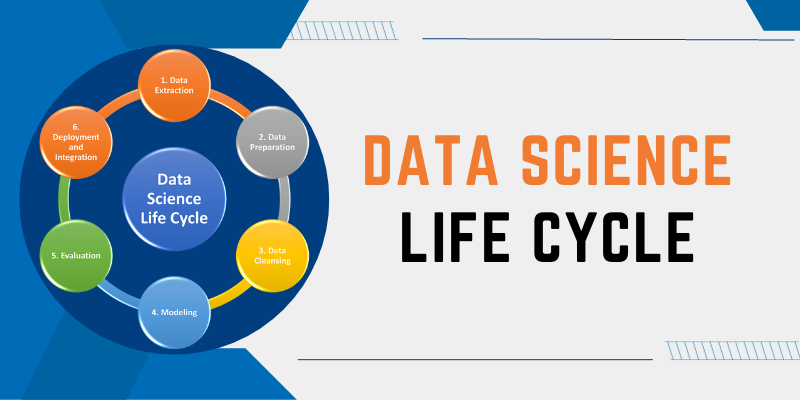
Data Science is the systematic study of data to generate knowledge and make predictions using testable approaches. It is the application of science to data from any source and size, and it is critical for organizations today. Understanding the data science scheme life cycle is crucial for Data Scientists, Machine Learning Engineers, and Project Managers. A Data Science course can help you understand the complete life cycle. This blog will examine the Steps in the Data Science Life Cycle. To know more about Data Science, join FITA Academy‘s Data Science Course in Coimbatore, which will provide you with a diverse skill set and the best Placement Training.
Steps Involved in Data Science Life Cycle
1. Problem Identification:
This is the most crucial stage of any Data Science endeavor. The first step is to understand how Data Science is valid in the domain under consideration and to find appropriate activities that are useful for the same. Domain experts and data scientists play significant roles in problem identification. The domain expert is well-versed in the application domain and understands the problem. Data Scientists understand the field and can assist in the discovery of challenges and feasible solutions.
2. Business Understanding:
Business objectives are established in response to customers’ requirements for making forecasts, increasing revenue, reducing losses, or enhancing the efficiency of various processes.
3. Collecting Data:
Data collection is an essential phase since it acts as the foundation for reaching specific business goals. In general, the information obtained from surveys is useful. At various phases, data is recorded in various software systems used by the organization, which is critical for understanding the process from product development to deployment and delivery. Historical data from archives can also be used to gain a better understanding of the business. Transactional data is also significant because it is collected daily. To extract critical business insights from data, many statistical approaches are used. Data is essential in data science projects. Enroll in the Data Science Course In Madurai, which will provide more concepts about Data Science Advantages.
4. Pre-Processing Data:
Large amounts of data are collected through archives, ordinary transactions, and intermediate records. The data is available in a variety of formats and forms. Some data may also be delivered in hard copy format. The data is distributed across different servers. This data is extracted, converted, and processed into a single format. A data warehouse is typically created to contain the Extract, Transform, and Load process or processes. This ETL operation is crucial in data science endeavours. A data architect is vital at this stage because they specify the structure of the data warehouse and perform the ETL procedures.
5. Analyzing Data:
Nowadays, that the data is available and ready in the required format, the next crucial step is to comprehend the data thoroughly. This understanding is gained by data analysis using various statistical tools. A data engineer is vital in data analysis. This is also known as exploratory data analysis (EDA). The data is analyzed by developing various statistical functions and finding dependent and independent variables or features. Data analysis determines whether data or attributes are essential, as well as data distribution. Various plots are used to present the data to improve comprehension. Tableau and PowerBI are well-known exploratory data analysis and visualization tools. Data Science skills in Python and R are required for performing EDA on any sort of data. Data Science Course in Pondicherry provides 100% Placement Assistance to all students who complete the training.
6. Data Modeling:
After the data has been analyzed and visualized, the next crucial step is data modelling. The main components are kept in the dataset, and the data is refined. The critical issue now is to decide how to model the data. What tasks lend themselves well to modelling? The quantity of economic value required determines which operations, such as classification or regression, are appropriate. Many modelling choices are available in these assignments as well. The Machine Learning engineer creates the result by applying multiple algorithms to the data. Many times, while modelling data, the models are first validated using dummy data comparable to the actual data.
7. Model Evaluation/Monitoring:
Selecting the most effective modelling approach is crucial due to the many available methods. The model is subsequently assessed using real-world data. In cases with a limited amount of data, ongoing monitoring is essential to track enhancements in the output. During the evaluation or testing phase of the model, data may change, potentially leading to significant alterations in the output. Enrolling in the Data Science Course In Hyderabad offers hands-on training in Data Science applications using Python, R, SQL, and other programming languages.
Also Read: Data Science Interview Questions and Answers